About Inflatable Welding Machines
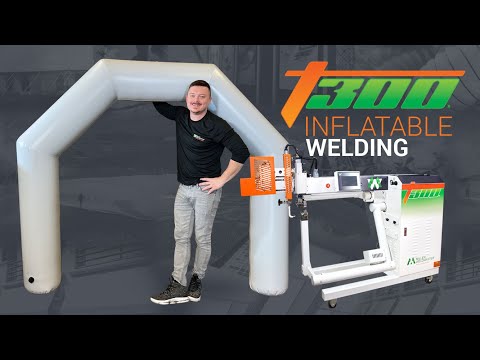
Inflatable welding machines use precisely controlled heat and pressure to fuse thermoplastic fabrics — PVC, TPU, and drop stitch — into airtight, watertight seams without adhesives or stitching. The result is a bond that becomes part of the material itself: stronger, more durable, and more consistent than anything glue can produce at scale. Miller Weldmaster builds hot air, RF and impulse welding machines for inflatables, led by the T300 Curve for curved and 3D seams.
This guide covers everything an inflatable manufacturer needs to evaluate hot air welding for their operation — how the process works, which materials it handles, how it compares to other welding methods, and how to match the right machine to your product type. Whether you're producing inflatable boats, bounce houses, military shelters, or drop stitch paddle boards, the information here will help you make a confident equipment decision.
要点
- Hot air welding creates airtight, watertight seams in thermoplastic inflatables by fusing material at the molecular level — no adhesives that degrade over time.
- Miller Weldmaster's T300 Curve and T600 Curve weld curved and 3D inflatable shapes, with dual arms for straight and curved seams.
- Hot air welding is significantly faster than gluing and creates airtight seams without the risk of glue weakening over time.
- PVC, TPU, and drop stitch (double-wall) fabrics each require different machine settings; the right welder must be configured for your primary material.
Miller Weldmaster's T300 Curve and T600 Curve
Both are purpose-built for inflatable manufacturers, with on-site installation and training included with every purchase.
How Inflatable Welding Machines Create Airtight Seams
Hot air welding is a thermoplastic bonding process that directs precisely heated air at a weld zone to soften two fabric surfaces, then fuses them together under pressure to create a permanent molecular-level seal. No thread. No adhesive. The bond becomes part of the material.
For inflatable manufacturers, hot air welding is the production standard for a straightforward reason: inflatables depend entirely on seam integrity. A single leak point — whether from a degraded glue joint, a broken thread, or a stress fracture at a hem — means a failed product. Hot air welding eliminates those failure modes by creating seams that are as strong as, or stronger than, the base fabric itself. Our guide to hot air welding for inflatables covers the process and its benefits in more detail.
The process is controlled by three variables: temperature, speed, and pressure. Operators set these parameters based on the fabric type and thickness. The machine drives heat into the weld zone while feed rollers apply pressure and move the material at a consistent rate. The result is a repeatable, production-quality seam every time — without the variability of hand-applied adhesive.
熱風溶接の仕組み
Think of a hot air welder as a sewing machine that uses heat instead of thread. A heated nozzle directs a controlled stream of hot air directly at the bonding surfaces of two fabric layers. As the material softens, a set of precision rollers applies pressure to press the surfaces together. The bond cools almost immediately as the material exits the weld zone, locking the molecular bond in place.
Three settings control every hot air weld, and our guide to hot air welding machines and their key uses covers them in depth:
- Temperature: set based on material type and thickness. PVC and TPU require different ranges.
- Speed: controls how long the material is exposed to heat. Slower speeds allow more heat penetration on thicker materials.
- Pressure: applied by the weld rollers. Must be calibrated to the material — too little and the bond is incomplete; too much and the material distorts.
On Weldmaster machines, the top and bottom weld rollers are independently controlled, which allows the operator to fine-tune pressure across both sides of the fabric — a critical feature for materials with different face and backing properties.
All About Inflatable Fabrics
Materials, Properties, and Weldability
Selecting the right hot air welding machine for inflatables starts with understanding the fabric you are working with. PVC-coated fabric, TPU (thermoplastic polyurethane), and drop stitch (double-wall) fabric are the three primary materials used in inflatable manufacturing — and each one has different welding requirements, and different types of inflatable fabric will influence seam performance and durability.
PVCコーティング生地
PVC-coated fabric is the dominant material in inflatable manufacturing. It offers a well-understood balance of durability, flexibility, and cost — and it responds predictably to hot air welding. PVC is used across virtually every inflatable product category: recreational and military boats, bounce houses, advertising structures, inflatable tents, and promotional products.
Welding PVC successfully requires accurate temperature control. PVC has a specific working range where the material softens enough to bond but does not degrade. Machines with precise digital temperature control — and stable airflow at the nozzle — produce consistent, repeatable PVC seams at production speed.
PVC also allows multiple seam configurations: overlap seams, hem seams, butt seams, and seams with cover strips. This versatility makes it the most flexible inflatable material to work with on a hot air welder.
TPU(熱可塑性ポリウレタン)
TPU is the premium choice for inflatable applications where PVC performance is insufficient. It delivers a higher strength-to-weight ratio, better resistance to UV degradation, and significantly better flexibility in cold temperatures — all critical factors for military inflatables, high-performance watercraft, and medical-grade bladders.
Hot air welding handles TPU well, but the process demands tighter control than PVC. TPU has a narrower working temperature range — push too far and the material surface burns or loses its structural properties. A machine with accurate, stable temperature output at the nozzle is not optional when welding TPU; it is a requirement.
For manufacturers working with both PVC and TPU in the same facility, the ability to quickly change and accurately reproduce material-specific settings between production runs is an important machine selection criterion.
Drop Stitch (Double-Wall) Fabric
Drop stitch fabric — also called double-wall fabric — is a construction where two coated fabric layers are connected by thousands of internal polyester threads of uniform height. When inflated, those threads hold a fixed thickness and the product becomes rigid. This is the technology behind inflatable paddle boards made with drop stitch welding, inflatable yoga mats, and a growing category of rigid inflatable structures.
Welding drop stitch requires a different approach than welding single-layer PVC or TPU. The fabric is stiffer and thicker, and the internal thread structure must not be damaged during the edge welding process. The panels also need to be precisely aligned and temporarily tacked together before the weld pass — otherwise, movement during welding creates misaligned seams and potential leak points.
Miller Weldmaster addresses this with the T300 Extreme Curve Double-Wall, which includes an ultrasonic cutter that cuts and temporarily tacks the top and bottom panels together before the weld. This keeps panels in alignment throughout the process and eliminates the need for manual clamping or glue tacking.
For drop stitch paddle board manufacturers specifically, replacing the traditional glue-based sidewall bonding process with hot air welding produces airtight seams without the labor intensity of adhesive application, removing a manual production step.
Welding Methods for Inflatables: Hot Air vs. Hot Wedge vs. RF
Hot air welding is the most versatile method for inflatables: it handles PVC, TPU and drop stitch and follows curved seams. Hot wedge suits long straight seams, and RF suits die-shaped parts in PVC, PU and TPU.
| 方法 | 仕組み | 最適な用途 | Seam Types | 制限事項 |
|---|---|---|---|---|
| 熱風溶接 | External heated air softens material surfaces; pressure rollers fuse them together | 2D and 3D inflatables; curved and complex seams; PVC, TPU, drop stitch | Overlap, hem, butt, curved, cover strip, double-wall | Requires accurate temperature and speed calibration per material |
| ホットウェッジ溶接 | Heated metal wedge contacts material and conducts heat directly; rollers apply pressure | High-volume straight seam production; thicker or stiffer materials | Overlap, hem, straight seams | Less flexible on curves and complex 3D shapes |
| RF(高周波)溶接 | Electromagnetic energy heats material internally; dies apply pressure to form the bond | PVC, PU and TPU inflatables and boat parts shaped with custom 2D or 3D dies | Overlap, hem, butt, channel and tube seams in die shapes | Each shape needs a custom die; Miller Weldmaster's drop stitch machine is hot air, not RF |
Inflatable Applications by Product Type
Hot air welding machines are used across a wide range of inflatable product categories. Each product type presents specific seam challenges — material selection, seam geometry, pressure requirements, or production volume — that the right machine must be equipped to handle.
Inflatable Boats and Watercraft
Inflatable boat manufacturing — from recreational dinghies to military assault craft — places the highest demands on seam performance of any inflatable category. Seams must hold pressure, resist water penetration, and withstand high-impact use in aquatic environments. A seam failure at sea is not a quality complaint; it is a safety incident, which is why many manufacturers rely on specialized hot air welding machines for inflatables to achieve consistent, watertight seams.
Boat hull geometries require curved seam capability. The forward sections of a hull, the bow chambers, and the tube-to-floor transitions all involve seams that follow a radius. Standard production welders without a curve arm cannot reliably execute these seams. This is precisely the application that the T300 Curve was designed for.
TPU is increasingly the material of choice for military and premium recreational boats because of its resistance to UV, cold, and abrasion. For manufacturers working with TPU, a machine with precise, stable temperature output is essential.
Inflatable Tents, Shelters, and Military Structures
Large-format inflatable shelters — field hospitals, command tents, decontamination units — require consistent seam quality across extremely long weld runs on large panel materials. The seams must hold pressure under load, resist weather penetration, and perform reliably in demanding field conditions.
Hot air welding delivers the consistency and speed this scale of production requires. The machine maintains constant temperature and pressure across a weld run that might span meters of fabric at a time. That consistency is difficult to replicate with adhesive, where application thickness and cure conditions vary.
Bounce Houses, Inflatable Games, and Advertising Structures
High-volume PVC inflatable production — bounce houses, inflatable obstacle courses, promotional characters, advertising inflatables — is a category where production throughput and cost-per-unit are the dominant buyer concerns. Seam quality matters, but speed and consistency at volume matter equally, especially for manufacturers creating creative inflatable products for entertainment and events.
Hot air welding automates the seaming process, eliminating the labor-intensive adhesive application step. Operators set parameters, feed material, and the machine produces repeatable seams without the handling time glue bonding requires. For manufacturers producing hundreds of units per month, this efficiency difference is significant.
Drop Stitch Paddle Boards and Rigid Inflatables
Drop stitch paddle boards are one of the most common drop stitch products. Traditional SUP manufacturing used glue to bond the sidewall fabric between the top and bottom panels — a process that is labor-intensive, inconsistent, and produces seams that weaken over time as the adhesive degrades.
Hot air welding replaces this process entirely. The T300 Extreme Curve Double-Wall option welds the drop stitch sidewall seam in a single pass, producing an airtight bond without adhesive. The integrated ultrasonic cutter tacks the top and bottom panels together before the weld pass, eliminating the alignment issues that manual methods create.
Switching to welding removes that manual gluing step and makes seams more consistent across the product line.
Seam Types for Inflatables: What Weldmaster Machines Can Produce
Overlap, hem, butt and cover strip seams run on a standard hot air welder; curved seams need a curve machine such as the T300 Curve, and drop stitch edge seams need the T300 Extreme Curve Double-Wall.
| シームタイプ | 説明 | 一般的なアプリケーション | Curve Arm Required? |
|---|---|---|---|
| Straight overlap seam | Two fabric layers overlap; both surfaces fused together | Flat panels, bladders, simple tent walls | いいえ |
| Hem seam | Fabric edge folded and welded to itself; creates reinforced finished edge | Boat tube edges, tent perimeters, panel borders | No — but curve arm extends capability to curved hems |
| バットシーム | Fabric edges butted together; cover strip welded over the join | Panel-to-panel joins in large inflatables and structures | いいえ |
| Overlap with cover strip | Overlap seam plus an additional strip welded over the top for reinforcement | High-stress joints in boats and military inflatables | No — but curve arm needed for curved versions |
| Curved / radius seam | Seam follows a curved path; requires the machine to guide fabric through a radius | Boat hulls, rounded tent panels, 3D inflatable shapes | Yes — curve arm required |
| Double-wall / drop stitch seam | Seam joins the perimeter edges of two-layer drop stitch fabric; special machine configuration required | SUP paddle boards, rigid inflatables, gym mats | Yes — T300 Extreme Curve Double-Wall |
How to Choose an Inflatable Welding Machine
To choose an inflatable welding machine, match it to five things: product shape, material, production volume, seam types and the support you need. Choosing the right welding machine for inflatable manufacturing is not primarily a price decision — it is a product compatibility decision. The wrong machine for your product shape or fabric type will produce seam failures, wasted material, and production delays. Here is a five-step framework for making the right selection.
Step 1: Identify Your Product Shape — 2D, 3D, or Curved
This is the first and most important question. If your products are flat-panel construction with straight seams only — some bladder shapes, simple flat advertising inflatables — a standard production welder may be sufficient. If your products have curved seams, rounded panels, or three-dimensional shapes — boats, rounded tent panels, 3D characters — you need a machine with a curve arm. There is no workaround for this requirement.
Step 2: Know Your Material
Your primary fabric determines the temperature range, airflow needs, and machine setup required for high-quality inflatable production. PVC offers a wide working temperature range and is the most forgiving material for hot air welding. TPU demands precise, stable temperature control due to its narrower working range. Drop stitch fabric requires a specialized double-wall machine with panel tacking capability. If working with multiple materials, ensure your machine can be configured and settings saved for each type.
Step 3: Define Your Production Volume
Production volume determines how much machine capacity you need. For low to mid volume, the T300 Curve is suitable for most inflatable manufacturing applications. For higher volume or larger formats, the T600 Curve offers greater throughput and capacity. For very high production demands, custom automated solutions are available from Miller Weldmaster.
Step 4: Evaluate the Seam Types Your Products Require
Review the seam type table in the previous section against your product designs. If any of your products require curved seams or drop stitch edge seams, eliminate any machine without the corresponding capability from your evaluation. A machine that can produce the seam types your products require is a baseline requirement — capability beyond that is a bonus.
Step 5: Assess Installation, Training, and Service Support
Machine capability is only part of the equation. Downtime is costly, and training your team affects your return on investment from day one. Miller Weldmaster includes on-site installation and training with every purchase, ensuring your team is ready to produce within about 1.5 days. Ongoing access to certified service support and spare parts is equally important for continuous production. Fast service response helps maintain your output capacity.
Miller Weldmaster Machines for Inflatable Manufacturing
Miller Weldmaster's main inflatable welding machines are the T300 Curve, T600 Curve and T300 Extreme Curve Double-Wall. Miller Weldmaster has designed and built fabric welding machines since 1974. The machines listed here are the core of the inflatable welding product line. For full specifications, application guidance, and a demo on your specific fabric, visit the individual machine pages or contact the Weldmaster applications team.
Besides the three hot air machines below, Miller Weldmaster's inflatable machines include the RFlex Press (RF welding with custom 2D and 3D dies, also listed for inflatable boats), the RFlex and RFlex Travel RF welders for PVC and PU, the Impulse Extreme (impulse welding, also listed for inflatable boats), the T600 Flex hot air and hot wedge welder, the EliteAir Industrial hand tool for repairs and the Seamvision infrared seam inspection system. See every inflatable machine in the machine finder.
T300 Curve — Versatile Curved Seam Welder
The T300 Curve is the primary machine for inflatable manufacturers producing 2D and 3D shaped products. The curve arm enables the machine to follow curved seam paths on boat hulls, rounded panels, and complex inflatable shapes that straight-seam welders cannot handle. The hot air system is compatible with PVC, TPU, and coated inflatable fabrics across a range of thicknesses.
The T300 Curve includes on-site installation and training with purchase.
T600 Curve — High-Capacity Inflatable Welder
The T600 Curve is the higher-capacity variant for manufacturers who need greater throughput, are working with larger inflatable formats, or are scaling production volume beyond what the T300 handles. It carries the same curved seam capability as the T300 in a platform built for higher production demands.
T300 Extreme Curve Double-Wall — Drop Stitch Specialist
The T300 Extreme Curve Double-Wall is purpose-built for drop stitch fabric applications: paddle boards, gym mats, and rigid inflatable structures. The machine includes an integrated ultrasonic cutter that cuts the edge of the double-wall fabric and temporarily tacks the top and bottom panels together before the weld pass — preventing panel movement and ensuring a clean, aligned edge seam.
This machine replaces the adhesive-based sidewall bonding process that traditional drop stitch manufacturing uses, eliminating a labor-intensive production step and producing consistently airtight seams without glue.
Ready to see how these machines perform on your specific fabric and product? Request a fabric test or virtual demo from Miller Weldmaster.
Installation, Training, and Getting Into Production
Purchasing a welding machine and getting into production are two different timelines. The gap between them depends on how well the equipment supplier supports the transition. Miller Weldmaster treats installation and training as a core part of the product, not an optional add-on.
On-Site Installation and Setup
After purchase, a Miller Weldmaster certified field service engineer is scheduled to visit your production facility for machine installation and setup. Installation includes physical placement and connection, machine calibration to your facility's electrical specifications, and initial test welds using your actual production fabric to confirm correct settings before your team takes over.
Getting the machine calibrated on your specific material before training begins means your team learns on a machine that is already set up correctly for your production environment — not on generic settings that may not match your fabric.
Training Your Production Team
Training covers machine operation, material-specific parameter settings (temperature, speed, pressure), seam setup for your product types, safety procedures, and basic maintenance. The goal is for your operators to be fully capable of running independent production by the end of the training visit.
Most customers are making products within approximately 1.5 days of machine delivery. That timeline reflects both the straightforward machine operation and the hands-on training approach Weldmaster uses — your team practices on your material, for your products, from day one.
Ongoing Service and Spare Parts
Production equipment requires ongoing support. Miller Weldmaster maintains a network of certified field service engineers for on-site service calls, a spare parts inventory for the full machine line, and a service team reachable for remote troubleshooting. For inflatable manufacturers running continuous production schedules, quick access to service is not a nice-to-have — it is a production risk management requirement.
Weldmaster also offers training resources for new operators joining your production team after initial installation, so your operation does not depend on a single trained employee for continued machine capability.