
About Ducting, Ventilation and Hose Welding Machines
Ducting, ventilation, and hose welding machines are industrial equipment that uses hot air or hot wedge welding to produce spiral, flexible, or straight-seam duct products from thermoplastic fabrics such as PVC, polyurethane, and polyethylene.
Miller Weldmaster builds machines for all three product types — ducting, ventilation tubes, and industrial hoses — serving manufacturers in agriculture, mining, HVAC, construction, and industrial production. Whether you need a compact hot air welder for HVAC duct fabric, a fully automated spiral duct line, or a large-diameter ventilation tube system for mine applications, this guide covers how these machines work, which machine fits which application, and what to look for when you're ready to buy.
Building industrial fabric welding machines since 1974, with US-based installation and service, Miller Weldmaster supports ducting manufacturers from commissioning through long-term production.
要点
熱風溶接
Hot air welding creates a molecular bond between thermoplastic layers, producing airtight duct seams that outperform sewn or adhesive-bonded alternatives in demanding ventilation applications.
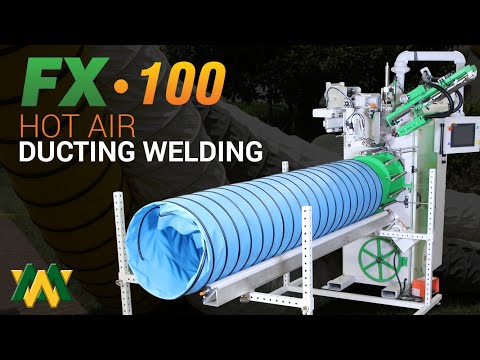
FX100 Spiral Duct Welding Machine
The FX100 is engineered for continuous helical seam production and can manufacture reinforced duct from 2 inches to 48 inches in diameter.
Wire Reinforcement and Wear Strips
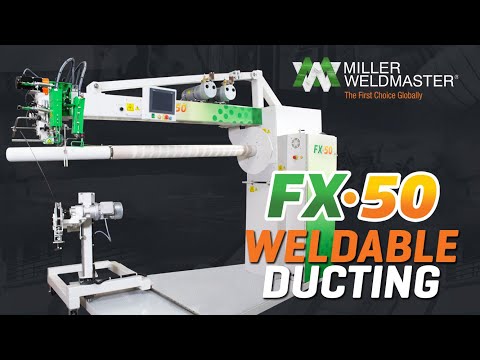
The FX100 and FX50 weld the reinforcing wire into the duct wall and can add a wear strip to the outside in the same production pass.
Weldable Ducting Materials
Weldable ducting materials include PVC, polyurethane, polyethylene and coated non-woven polyester, with each material using specific welding parameters stored as repeatable weld recipes.
Understanding Ducting, Ventilation, & Hose Welding Machines
The Three Product Types: Ducting, Ventilation Tubes, and Industrial Hoses
These three product categories share the same core manufacturing method but differ in geometry, diameter range, materials, and end-use requirements.
- Ducting: Flexible or spiral air-handling tubes produced from thermoplastic-coated fabric. Used in HVAC air distribution, agricultural ventilation, and construction site air handling. Typically PVC or polyurethane coated fabric, produced in a wide range of diameters.
- Ventilation tubes: Heavy-wall fabric tubes used for mine ventilation, tunnel ventilation, and large-scale industrial exhaust. Often require very large diameters, high structural durability, and in some applications, integrated wire reinforcement or attachment eyelets.
- Industrial hoses: Reinforced tubes for dust collection, CNC machine extraction, fluid conveyance, and specialty industrial applications. Materials are often chosen for abrasion resistance (polyurethane) or chemical resistance (PVC), and wire reinforcement is common.
Why Thermoplastic Welding, Not Metal Forming
Flexible fabric ducts are fundamentally different products from rigid sheet metal ducts. They're manufactured from rolls of thermoplastic-coated fabric — PVC, polyurethane, polyethylene, or non-woven polyester — that must be fused, not bent or locked. Metal duct forming equipment (spiral formers, lock-seam machines, plasma cutters) has no application in this category.
Hot air welding is the dominant method because it works with the thermoplastic chemistry of the coating. When the coating reaches the correct temperature, it flows and bonds to the adjacent layer under pressure. The resulting seam is a single fused thermoplastic mass — not a mechanical joint, not an adhesive interface.
This matters in end-use: a welded seam on a mine ventilation tube stays sealed under the repeated flexing, pressure cycling, and rough handling that characterize underground applications. A sewn seam has needle holes. An adhesive seam can delaminate.
Industries That Use Flexible Duct and Hose Welding Machines
Flexible thermoplastic duct and hose products are critical components across a wide range of industries, and Miller Weldmaster offers dedicated ducting, ventilation, and hose welding solutions to support these applications. Agriculture relies on them for ventilation and crop storage. Mining depends on them to move fresh air into underground workings. HVAC manufacturing uses them for flexible air distribution in residential and commercial buildings. Industrial facilities need them for dust collection, fume extraction, and process air handling.
Each industry places distinct demands on the duct product — and by extension, on the machine that produces it. Understanding those demands is the starting point for selecting the right welding equipment.
農業
Agricultural applications include grain storage ventilation, greenhouse airflow systems, and livestock housing ventilation. Flexible fabric ducting is preferred in these environments for its light weight, resistance to moisture, and ability to be routed through confined spaces.
Agricultural duct typically requires variable diameter options to serve different barn or storage sizes, and UV-resistant material grades for applications with outdoor or high-light-exposure runs. Production volumes in agricultural duct manufacturing often run in medium-to-high volumes, making consistent seam quality across long production runs an important machine capability.
Mining and Underground Ventilation
Mine ventilation is one of the most demanding applications for flexible duct welding machines. Underground workings require continuous airflow to dilute and remove hazardous gases, control temperature, and maintain breathable conditions for workers. Ventilation tubes in this environment must handle very large diameters — sometimes exceeding one meter — rough handling during installation, and sustained air pressure over long tunnel lengths.
Wire reinforcement is standard in mine ventilation tube production. The wire helix gives the tube structural rigidity so it holds its circular cross-section even when suspended from tunnel ceilings. Wear strips on the exterior protect the tube at anchor points and contact zones.
The production efficiency gain from automated welding in this application is significant: Miller Weldmaster's FX100 welds seams at up to 18 meters (60 feet) per minute and the FX50 at up to 10 meters (30 feet) per minute, depending on the application and material, which lowers cost per meter and improves a manufacturer's ability to fulfill large contracts on schedule.
HVAC and Building Construction
Flexible HVAC duct fabric is produced in high volumes for residential and commercial air distribution systems. The thermoplastic-coated fabric is typically welded into flat panel sections or spiral tubes that connect to rigid ductwork, branch from plenums, or serve as flexible connectors between fixed duct sections.
In HVAC applications, consistent seam quality matters because leaky duct seams reduce system efficiency, increase energy costs, and create comfort complaints. A welded seam eliminates the thread degradation, adhesive failure, and needle-hole air leakage that can develop in sewn or glued duct over time. The T300 hot air welder is a popular production choice for this application: high-volume production of coated and laminated thermoplastic HVAC duct fabric, with recipe-stored welding parameters for operator repeatability across shifts.
Industrial Dust Collection and Fume Extraction
Industrial hoses for dust collection, CNC machine extraction, and the removal of fumes and smoke from industrial processes are produced from thermoplastic fabrics selected for abrasion resistance and chemical compatibility. Polyurethane is the preferred material for abrasive-duty applications — dust collection from woodworking, metalworking, and aggregate handling — because of its superior wear resistance and flexibility at low temperatures. Exhaust ducts also remove moisture and pollutants from indoor spaces and are especially important where contaminated air must be captured at the source.
PVC is the more common material for general-purpose industrial ventilation hose, where chemical resistance and cost-effectiveness are the primary requirements. Both materials are compatible with Miller Weldmaster hot air welding machines, and weld recipe storage allows operators to switch between materials without relearning settings from scratch.
Aerospace and Specialty Applications
Aerospace-grade flexible ducting requires tighter dimensional tolerances, specific material certifications, and seam quality standards that exceed general industrial requirements. The FX100's precise temperature control, variable wire pitch, and configurable wire former capability make it a fit for aerospace duct production where geometry consistency and seam integrity are critical.
The Hot Air Welding Process for Ducting
Hot air duct welding follows a consistent sequence, whether the machine is a compact T300 for HVAC duct fabric or an FX100 for automated spiral duct production:
- Material feeding: Thermoplastic fabric is fed from an unwind roll with tension control to maintain consistent material positioning throughout the weld.
- Heating: A heated air nozzle directs precisely controlled hot air at the thermoplastic surface, raising the coating temperature into the weld zone — the range where the thermoplastic flows and becomes bondable.
- Pressure: Pressure rollers apply consistent force to the softened surfaces, pressing them together and initiating the molecular bond between layers.
- Cooling: The bonded seam cools rapidly after the pressure zone, solidifying into a continuous fused joint.
- Spiral path (for FX-series machines): For spiral duct production, the welding process follows a helical path as the material rotates on the forming mandrel. The wire former simultaneously shapes the reinforcing wire to the correct helix diameter and feeds it into the weld zone.
Temperature, speed, and pressure are the three variables that determine seam quality. Miller Weldmaster machines store these settings as named weld recipes, allowing operators to recall exact parameters for a given material and product without manual readjustment between runs.
Why Seam Welding Outperforms Sewn or Adhesive-Bonded Alternatives
Welded duct seams are airtight: they have no needle holes and no adhesive layer to fail, so they hold up better than sewn or glued seams under flexing, UV and chemical exposure.
Buyers evaluating duct welding machines often come from operations that currently sew or glue their duct products. The performance difference between welded and non-welded seams is significant, and it compounds over the product's service life.
- Vs. sewing: Industrial sewing creates needle holes at every stitch. In an airtight duct application, every hole is a potential leak point. Thread also degrades with UV exposure, chemical contact, and repeated flexing — all common in agricultural, mining, and industrial environments. A welded seam has no holes and no degradable fastening element.
- Vs. adhesive bonding: Adhesive bonds depend on a chemical interface between the adhesive and the substrate. Temperature cycling, chemical exposure, and mechanical stress can weaken that interface over time. A thermoplastic weld is not an interface — it is a single fused material zone. There is no separate bonding agent to fail.
- Seam strength: A properly executed hot air weld on compatible thermoplastic materials produces a seam that can match or exceed the strength of the base fabric.
Adding Wire Reinforcement and Wear Strips
Wire reinforcement is integrated into the ducting welding process — not added as a separate step. On the FX100 and FX50, a heavy wire former bends the reinforcing wire to the correct helix diameter as the tube is being formed. The wire is fed into the spiral seam zone so that the welding process encapsulates it within the duct wall in a single continuous pass.
Wear strips — strips of heavier material applied to the exterior of the tube at high-wear locations — can also be applied in the same production pass. For mine ventilation tubes that are dragged across rough floors or secured to roof bolts, wear strips significantly extend service life without requiring a second production operation.
Miller Weldmaster Ducting, Ventilation, and Hose Welding Machines
Miller Weldmaster's ducting machine lineup covers all three product types — flat HVAC duct fabric, flexible reinforced spiral duct, and large-diameter ventilation tubes — at both standard and fully automated production levels. The right machine for a given operation depends on product geometry, diameter range, production volume, and whether wire reinforcement is required.
Miller Weldmaster's ducting machines include the FX100 flexible spiral ducting welding machine (reinforced duct from 2 to 48 inches), the FX50 large flexible ducting welding machine (15 inches and up, with wear strips), the Moduline Ducting automated ventilation ducting line (welds panels, applies T-tape, adds grommets and cuts to length), the T300 Flex hot air and hot wedge welder for HVAC duct fabric, the Seamvision infrared seam inspection system and the GRW2400 heavy-duty rewind. Complete automated lines are on the automated flexible ducting production page, and every ducting machine is in the machine finder.
FX100 — Flexible Spiral Ducting Welding Machine
The FX100 is an automated hot air welding system engineered specifically for continuous spiral seam production in flexible reinforced ducts and industrial ventilation tubing. It integrates material handling, spiral forming, wire insertion, and seam welding into a single automated process — producing airtight spiral duct at production speeds that manual methods cannot match.
The FX100 is the right machine for manufacturers producing HVAC flexible duct, agricultural ventilation tubing, and medium-to-large diameter industrial hose at consistent volumes; the FX100 duct welding machine guide explains how it streamlines flexible duct manufacturing. Key capabilities include:
- Diameter range: 2" to 48"
- Variable wire diameter and wire pitch: Adjustable to accommodate different reinforcement specifications without retooling the line
- Heavy wire former: Capable of bending wire up to.250" diameter for a wide range of finished products
- Take-away system: Manages multiple ducting lengths as they come off the machine, reducing operator handling
- Fabric tension control: Consistent material handling across different fabric weights and widths
- Custom configuration: Can be designed for specific application requirements
FX50 — Large Flexible Ducting Welding Machine
The FX50 is designed for large-diameter flexible reinforced ducting, welding tubes from 15 inches upward with optional wear strip integration. Where the FX100 covers a broad spiral duct diameter range with high automation, the FX50 targets the heavy-duty, large-format end of the market — mine ventilation tubes, large industrial exhaust ducting, and reinforced hose in diameters that exceed typical HVAC flexible duct specifications.
Wear strip integration is a key FX50 capability. For mine ventilation tubes that are subject to abrasion during installation and service, a wear strip applied at the machine eliminates a separate secondary operation. The FX50 handles this in-process, maintaining production throughput.
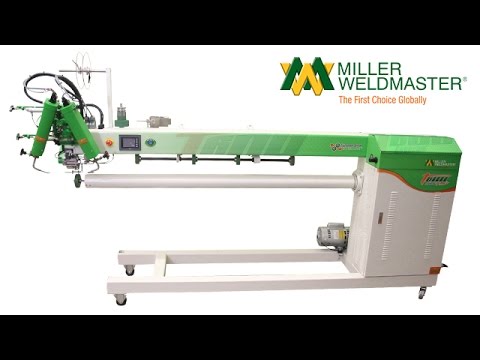
T300 — Hot Air Welder for HVAC Duct Fabric
The T300 is a precision hot air welder designed for high-volume production of coated and laminated thermoplastic HVAC duct fabric. It produces flat and overlap seams without thread or adhesive, making it the right machine for manufacturers producing flat duct panels, duct liner sections, and overlap-seam flexible duct connectors.
The T300 supports both hot air welding and hot wedge welding, giving operators flexibility for different material types and seam geometries. Our article on the T300 hot air welder for HVAC duct fabric shows how manufacturers use it in production. Weld recipe storage is a core feature: operators save the correct temperature, speed, and pressure combination for a given material and can recall it instantly at the start of each run, eliminating the setup variability that drives seam quality inconsistencies in high-shift production environments.
The T300 Flex version features a precision welding head and adjustable heating head for enhanced accuracy on challenging materials. For HVAC duct fabric manufacturers running multiple product lines with different material specifications, recipe storage and dual welding mode capability significantly reduce changeover time and quality risk between runs.
Custom Automated Solutions for Ducting and Ventilation
High-volume ducting operations — mine ventilation tube lines, specialty hose production, integrated cut-and-grommet systems — often need production capabilities beyond what standard machine configurations provide; Miller Weldmaster builds these as custom converting equipment. Miller Weldmaster engineers custom automated solutions that combine fabric unwinds, automated length control, in-process grommet insertion, multi-head welding configurations, and automated cut-off into a single continuous production line.
The result is a system that takes raw fabric rolls at one end and delivers finished, measured, cut-to-length duct products at the other — with consistent weld parameters, minimal operator intervention, and no separate secondary operations.
Ready to find the right machine for your ducting, ventilation tube, or hose application? Contact a Miller Weldmaster sales engineer or schedule a virtual demo.
Choosing the Right Machine: A Buyer's Selection Guide
Match the machine to the duct you make: the FX100 for wire-reinforced spiral duct from 2 to 48 inches, the FX50 for large-diameter duct from 15 inches up with wear strips, the T300 for flat HVAC duct fabric seams, and a custom automated line such as the Moduline Ducting for high-volume ventilation tube.
| Product Type | Typical Material | Recommended Machine | 最適な用途 |
|---|---|---|---|
| Flexible spiral duct (small-to-medium diameter) | PVC, polyurethane, non-woven polyester coated fabric | FX100 | HVAC flexible duct, agricultural ventilation tubing, industrial hose — continuous automated spiral production |
| Large-diameter reinforced duct / heavy ventilation tube | Heavy PVC, polyethylene, reinforced fabric | FX50 | Mine ventilation, large industrial exhaust ducting — large diameter with wear strip integration |
| Flat / laminated HVAC duct fabric (panel seams) | Coated thermoplastic fabric, laminated PVC | T300 | HVAC duct panel production, duct liner seaming, high-volume flat seam applications |
| High-volume continuous production / custom line | Any thermoplastic duct fabric | Custom Automated Solution | Mine ventilation tube lines, specialty hose production, integrated grommet and cut-off systems |
How to Choose a Ducting Welding Machine
Beyond matching machine to product type, buyers should evaluate the following criteria when comparing duct welding equipment options:
Step 1 – Diameter Range Coverage
Confirm whether the machine can handle your entire product size range without needing separate machines or significant retooling. Check the minimum and maximum diameters it can produce in a single setup. This ensures efficient production without downtime for adjustments.
Step 2 – Wire Reinforcement Integration
If your product requires wire reinforcement—as most mine ventilation tubes and many industrial hoses do—the machine should integrate wire insertion in-process rather than as a separate step. This integration significantly improves throughput and reduces labor costs. Machines with in-process wire insertion streamline production by combining forming, wire feeding, and welding into a continuous operation, enhancing efficiency and product consistency.
Step 3 – Material Compatibility
PVC, polyurethane, and polyethylene require different welding temperature ranges and pressure settings, and understanding thermoplastic welding fundamentals helps ensure those parameters are correctly defined. Some duct materials, such as PTFE-coated glass fiber, are not thermoplastic and can't be hot air welded, so confirm every material in your product line before selecting a machine.
Step 4 – Production Speed and Automation Level
For low-to-medium volume production, semi-automatic or standard machines offer the best capital efficiency. Fully automated systems are more cost-effective for high-volume continuous production, delivering lower cost per meter with minimal operator intervention. Choose the automation level based on your specific production volume and operational needs.
Step 5 – Service and Support Availability
Industrial welding machines are significant capital investments designed for long-term use. Ensure that installation support, operator training, spare parts availability, and ongoing service are included or easily accessible. Having US-based service and support can reduce response times and minimize supply chain risks compared to international sourcing.
Materials Used in Flexible Duct and Ventilation Hose Production
PVC, polyurethane, polyethylene and coated non-woven polyester are the four thermoplastic fabrics most used for welded duct and hose. All four are hot air welded; polyethylene can also be hot wedge welded.
| 素材 | Common Duct Applications | Key Properties | 溶接方法 |
|---|---|---|---|
| PVC (polyvinyl chloride) | HVAC flexible duct, mine ventilation, agricultural ventilation, general industrial ducting | Cost-effective, flexible over a wide temperature range, good chemical resistance, widely available in coated fabric form | 熱風溶接 |
| Polyurethane (PU) | Industrial dust collection hose, abrasion-duty ducting, CNC extraction hose | Superior abrasion resistance, flexible at low temperatures, chemical resistance, longer service life in high-wear applications | 熱風溶接 |
| Polyethylene (PE) | Agricultural irrigation and ventilation, general-purpose tubing, moisture-exposed applications | Lightweight, moisture resistant, UV-stable grades available, lower cost than polyurethane | Hot air or hot wedge welding |
| Non-woven polyester (coated) | Positive air handling duct, lightweight ventilation tube, industrial air distribution | Lightweight, tear-resistant, compatible with PVC or polyurethane coatings, good tensile strength for weight | 熱風溶接 |
Automating Your Ducting and Hose Production
Manual flexible duct welding is inherently labor-intensive, speed-limited, and variable. An operator guides the weld path, manages material tension, and monitors temperature by observation. At low volumes, this is workable. At medium-to-high volumes, the labor cost per meter of duct rises, the reject rate from inconsistent welds creates material waste, and production capacity is limited by how fast a person can work.
Automation addresses all three constraints simultaneously, as Miller Weldmaster's automated spiral ducting production lines show. It removes the operator from the weld path, maintains consistent parameters regardless of shift length or operator experience, and enables production speeds that are physically impossible with manual methods.
What Automation Replaces in Manual Duct Production
A fully automated duct welding system integrates steps that are separate, labor-dependent operations in a manual production environment:
- Operator-guided welding path: On an automated spiral duct machine, the helical seam path is maintained mechanically by the rotation of the forming mandrel and the feed rate of the material. No operator guidance is required to keep the weld on the seam.
- Manual material feeding and tension: Automated fabric unwinds with tension control replace the operator's role in managing material feed and preventing distortion at the weld zone.
- Separate wire insertion: Wire reinforcement is fed into the process automatically by the wire former — no separate reinforcing step required after welding.
- Manual cut-off and length measurement: Automated cut-off systems activate when the tube reaches the programmed length, producing consistent product dimensions without operator measurement at each cycle.
- Separate wear strip application: On machines with wear strip capability, the strip is applied in the same production pass as the seam weld — not as a second operation after the tube is formed.
Production Efficiency Gains from Automated Duct Welding
Automated duct welding raises throughput because the machine, not the operator, holds the weld path, speed and temperature. Miller Weldmaster's FX100 welds seams at up to 18 meters (60 feet) per minute and the FX50 at up to 10 meters (30 feet) per minute, depending on the application, and the Moduline Ducting line welds panels together, creates and applies T-tape, adds grommets and cuts tubes to length in one automated system. At that scale, the labor cost per meter drops dramatically, and the production capacity to fulfill large ventilation contracts becomes achievable.
Beyond raw throughput, automation produces consistency gains that have their own economic value. Consistent weld parameters mean a lower reject rate and a lower rework rate. Consistent product dimensions mean better fit on installation. Consistent seam strength means fewer field failures and warranty returns.
When Semi-Automated or Manual Welding Makes Sense
Full automation is not the right choice for every ducting operation. It is most cost-effective when production volumes are high, product lines are consistent, and the labor savings compound over a sustained production run. For lower-volume production, short-run custom orders, or operations producing a wide variety of product specifications, the capital investment in a fully automated line may not return quickly enough.
In these situations, the T300 or a semi-automatic machine provides a better capital-to-output fit. The T300's recipe storage and dual welding mode capability still deliver significant quality and consistency advantages over fully manual methods, without the capital cost of a custom automated line. Miller Weldmaster's range of machines at multiple automation levels means the right fit for the actual production requirement — not an overbuilt solution that sits underutilized.
Service, Training, and Support for Ducting Welding Equipment
Industrial welding machines are capital equipment. The decision to purchase one is not completed at the point of sale — it extends through installation, operator training, ongoing production support, and machine maintenance over a multi-year service life. For buyers evaluating ducting welding equipment, post-sale support capability is as important as machine specification.
Miller Weldmaster provides US-based installation, training, and service for all ducting welding machines, and even offers certified used fabric welding machines for operations seeking lower capital cost options.
Installation and On-Site Training
After purchase, a Miller Weldmaster certified field service engineer contacts the buyer to schedule installation and training at the facility. The installation process covers machine setup, material handling configuration, and initial weld parameter dialing for the buyer's specific materials and product specifications.
Operator training covers machine operation, weld recipe setup and management, routine maintenance procedures, and product quality inspection. The goal is a production team that can operate the machine confidently and troubleshoot common production issues without requiring a service call for every deviation.
Ongoing Service and Spare Parts
Spare parts are available directly through Miller Weldmaster's service infrastructure, with US-based fulfillment that reduces lead times compared to internationally sourced equipment.
For ongoing technical questions, production challenges, or machine adjustments as product lines evolve, the Miller Weldmaster service team is reachable through the dedicated service contact process. This support infrastructure is a practical advantage for ducting manufacturers whose production schedules don't accommodate extended machine downtime waiting for international shipping of parts or remote troubleshooting across time zones.