About Tarpaulin Welding Machines
Tarpaulin welding machines heat-bond thermoplastic coated fabrics such as PVC, vinyl and PE into waterproof seams for truck tarps, covers and side curtains. Inconsistent seam quality, slow throughput, and equipment that can’t keep pace with material variety are the most common reasons tarp manufacturers look for a better welding solution. A tarpaulin welder that’s properly matched to your materials and production volume plays a critical role in ensuring durable, long-lasting seams—an essential factor for business success. These welders permanently bond thermoplastic coated fabrics into seams that are waterproof, tear-resistant, and stronger than sewn seams.
Miller Weldmaster has engineered industrial tarp welding machines since 1974. The company is committed to providing reliable solutions for businesses seeking to create durable tarpaulin products. Miller Weldmaster designs, builds, and supports hot air, hot wedge, and RF welding equipment for tarp manufacturers, fabricators, and production facilities across transportation, construction, agriculture, and specialty manufacturing. If you’re producing truck tarps, protective covers, soft side curtains, or any coated fabric product at scale, this page covers what you need to evaluate the right machine for your operation.
What Tarp Manufacturers Need to Know Before Buying a Welder
- A tarpaulin welding machine permanently heat-bonds thermoplastic coated fabrics — such as PVC, PE, and vinyl — to produce seams stronger and more weatherproof than stitched alternatives.
- Miller Weldmaster designs and engineers industrial tarp welding machines for production environments, including hot air, hot wedge, and RF technologies across multiple output configurations.
- The right tarpaulin welder for your operation depends on material type, production volume, seam type (overlap, hem, pipe), and whether you need a manual, semi-automatic, or fully automated setup.
- Miller Weldmaster machines weld truck tarps, soft side curtains, protective covers, coated tarpaulin sheets, and custom fabricated products.
- Post-sale support — including application training, spare parts, and direct access to engineering — is a primary differentiator when selecting an industrial tarp welding equipment supplier.
What Does a Tarpaulin Welding Machine Actually Do?
A tarpaulin welding machine is a heat-based fabrication tool that permanently joins thermoplastic coated fabrics by melting the material at the weld point — producing a seam that is waterproof, tear-resistant, and stronger than stitching. Unlike sewing, which punctures the fabric with a needle and leaves thread exposed to UV degradation and moisture infiltration, welding fuses the material at a molecular level. The result is a continuous sealed bond with no holes, no thread, and no secondary sealing required. The key benefits of using a tarpaulin welder include maximizing seam strength, efficiency, and durability, which leads to reliable results and longer-lasting tarps.
Tarpaulin welders are used in both production fabrication — creating new tarp panels and products from raw coated fabric — and repair applications, patching or re-seaming existing tarp materials. For production environments, the right machine configuration directly determines throughput speed, seam consistency, and overall product quality. For step-by-step setup on PVC tarps, see our guide on how to weld heavy-duty tarpaulins.
Materials Compatible with Industrial Tarp Welders
Industrial tarpaulin welding machines are compatible with a wide range of thermoplastic coated and homogeneous materials. Material type determines which welding technology is optimal — and Miller Weldmaster machines are configured specifically for the materials you run. Our machines are suitable for welding coated PVC-P, coated tarpaulins, membrane liners, and foils, in addition to the following:
- PVC-coated polyester — the most common tarp material; compatible with hot air, hot wedge, and RF welding
- Coated PVC-P — ideal for durable seams on tarps, membranes, and inflatable models
- Polyethylene (PE) — widely used in agricultural covers and construction tarps; hot air welding preferred
- Polypropylene (PP) — lighter weight applications; requires careful temperature control
- Vinyl — truck tarps, curtain-side trailers, and industrial covers; hot air and hot wedge both applicable
- Coated tarpaulins — specialized covers and sheets for industrial, construction, and transportation applications
- Coated polyester and coated canvas — heavy-duty industrial and military applications
- Thermoplastic polyolefin (TPO) — roofing membranes and industrial liners
- Membrane liners — used in pools, biotopes, and inflatable boats, requiring precision and compatibility
- Foils — for coated tarpaulins, membrane liners, and other waterproof or protective covers, with or without reinforcement
- Mesh and open-weave coated fabrics — scaffold wraps, shade structures, and windbreaks
If you’re unsure whether your material is weldable or which technology applies, Miller Weldmaster’s application engineers can evaluate a material sample and recommend the right machine configuration.
Welding vs. Sewing — Why It Matters for Tarp Production
When evaluating tarp fabrication methods, the comparison between welding and sewing comes down to three things: seam integrity, production efficiency, and long-term durability. Welding is the ideal choice for manufacturers seeking superior seam integrity and durability, as it creates strong, tightly sealed bonds that outperform stitched seams. Stitching is faster to set up on a small scale but introduces real performance limitations that affect the end product. Our tarp heat sealing and stitching guide covers when each method fits.
| 縫い目 | 溶接継ぎ目 | |
|---|---|---|
| 防水 | Needle holes allow water infiltration | Continuous sealed bond — fully waterproof |
| シーム強度 | Limited by thread tensile strength | Continuous bond across the full seam width |
| 生産速度 | Moderate; multi-pass often required | High-speed single pass on automated equipment |
| Material Waste | Higher; requires overlap allowance for thread grip | Lower; precise heat application reduces waste |
| Long-Term Durability | Thread degrades under UV and mechanical stress | No thread to degrade; seam maintains integrity |
Which Welding Technology Is Right for Your Tarp Application?
The right welding technology depends on three variables: the material you’re running, the seam configuration you need, and your production volume. Miller Weldmaster offers hand tools, semi-automatic machines and fully automated tarp welding systems, so the setup can match your production needs. Their range includes hot air, hot wedge, and RF welding. Each technology offers distinct advantages for specific tarp applications. Miller Weldmaster matches the technology to the output, not the other way around.
Hot Air Welding for Tarpaulins
Hot air welding is the most widely used method for PVC-coated and thermoplastic tarp materials. A precisely controlled stream of heated air is directed at the overlap zone between two fabric panels, softening the thermoplastic coating. Pressure rollers then compress and fuse the panels as the material cools — creating a continuous, sealed seam in a single pass.
Hot air welding suits overlap seams, hem seams, and pipe welding. It's available in both hand tool configurations for low-volume repair work and fully automated machine configurations for high-speed production. Automated hot air welding machines from Miller Weldmaster can process long tarp seams at speeds that far exceed what manual fabrication or sewing can achieve — making it the go-to choice for tarp manufacturers with high-volume output targets.
Hot Wedge Welding for Covers & Tarps
Hot wedge welding uses a heated metal wedge inserted between two overlapping fabric panels to heat both surfaces simultaneously before pressure rollers compress and fuse them. It’s the preferred method for heavier-weight materials and continuous long-seam production — particularly for truck tarps, where durable, airtight seams are essential, and for industrial protective covers. This technique is also commonly used for products like swimming pool liners and covers, ensuring seam integrity under mechanical stress in various applications.
Because the heat source is direct contact rather than airflow, hot wedge welding delivers consistent energy transfer even on thicker material profiles. For operations running heavy-duty coated fabrics in high volumes, hot wedge equipment from Miller Weldmaster offers the combination of speed, consistency, and seam strength that production environments require. Regular repairs and maintenance of hot wedge welding equipment are crucial to ensure consistent performance, minimize downtime, and extend the lifespan of your tarpaulin welder and tarps.
RF Welding for Precision Tarp Fabrication
RF (radio frequency) welding uses high-frequency electromagnetic energy to excite the molecules within PVC-coated fabrics, generating heat through molecular friction and forming a strong, durable seal. This form of welding heats the material from the inside out, similar to how a microwave works, resulting in exceptionally clean and precise seams. These advantages make RF welding well suited for shaped or contoured tarp products where dimensional accuracy and seam aesthetics matter.
RF welding excels in applications requiring complex seam geometries that hot air or hot wedge equipment can’t efficiently produce. When choosing between RF and hot air, the key factors are material type (RF works on PVC and PU), seam complexity, and production volume.
Tarp Welding Technology Decision Guide
The table matches common tarp materials and volumes to the welding technology that usually fits them.
| 素材タイプ | Production Volume | Best Technology |
|---|---|---|
| ポリ塩化ビニル(PVC)コーティングポリエステル | High-volume continuous | Hot Air (automated) |
| Heavy vinyl / truck tarp material | High-volume continuous | ホットウェッジ |
| PVC-coated fabric, shaped products | Medium volume | RF溶接 |
| PE / poly construction tarps | Medium to high volume | ホット・エア |
| Mixed materials, varied seam types | 可変 | Multi-technology platform |
Tarpaulin Products Miller Weldmaster Machines Are Built to Produce
Miller Weldmaster equipment is installed in production facilities making a wide range of tarpaulin and coated fabric products, including machines designed to weld coated tarpaulins, inflatable boats, and signs. Each product category has distinct seam requirements, material profiles, and output demands. The machine configurations below are matched to those specific requirements.
Truck Tarps and Soft Side Curtains
Truck tarps and soft side curtains are among the most demanding tarp fabrication applications. Long seam runs, reinforcement welding at corners and attachment points, and hemmed edges with pocket welds all require a machine platform that can handle multiple seam configurations without retooling between jobs.
Miller Weldmaster machines handle the full scope of truck tarp production — from continuous overlap seams on PVC or vinyl material to hem welding and reinforcement zones. Side curtain configurations for curtain-side trailers require consistent seam width and weld strength across the full panel length. Automated machine configurations deliver that consistency at production speeds that manual fabrication can't match.
Protective Covers and Industrial Tarps
Construction site tarps, equipment covers, scaffold wraps, and temporary structural covers are designed for extended outdoor exposure. Material durability under UV, wind, and moisture loading is the primary performance requirement — and the seam quality produced by welding directly supports that durability. Stitched seams on protective covers degrade faster under the same conditions.
Miller Weldmaster machines work with poly, coated canvas, mesh, and vinyl configurations used in industrial protective cover applications. For operations producing large-format covers, automated welding equipment significantly reduces labor time per unit while delivering consistent seam quality across the full production run.
Custom Tarp Fabrication — Beyond Standard Shapes
Not every tarp product fits a standard template. Shaped covers, multi-layer assemblies, reinforced perimeter constructions, and specialty containment liners require fabrication equipment engineered to match the product geometry — not adapted from a catalog configuration.
Miller Weldmaster's application engineering team works directly with customers to design machine configurations for products that standard equipment can't handle. Miller Weldmaster can configure or engineer equipment to your specific output requirements — material type, seam configuration, panel dimensions, and production volume included.
Why Tarp Manufacturers Choose Miller Weldmaster
Every industrial tarp welding equipment supplier can describe machine specifications. Fewer can point to application-specific manufacturing experience since 1974, a team of engineers who've worked through the specific challenges of tarp fabrication, and a post-sale support structure built for production environments where downtime costs real money.
Fabric Welding Experience Since 1974
Miller Weldmaster has been designing and manufacturing fabric welding equipment since 1974. That track record represents decades of application refinement across tarp types, material generations, and production environments. When PVC formulations changed, when new coated fabrics entered the market, when customers pushed for higher output speeds, Miller Weldmaster's engineering team adapted the equipment accordingly.
That institutional knowledge shows up in machine performance. Weld temperature profiles, pressure roller configurations, and seam control systems reflect real-world learning from installations across many tarp production facilities. Buyers who choose Miller Weldmaster are getting equipment informed by that experience, not just a machine built to a spec sheet.
Application Engineering
Miller Weldmaster doesn't sell machines from a fixed product catalog and leave buyers to figure out the details. The application engineering process starts with your specific requirements: what materials you're running, what seam configurations you need, what your production throughput targets are, and what your floor space and labor constraints look like.
From that starting point, the engineering team configures a machine solution matched to your operation. For standard applications, that means selecting from an established range of proven configurations. For specialized applications, it can mean custom machine design. Either way, the process is collaborative — and the output is equipment that fits your production line, not the other way around.
Post-Sale Support, Spare Parts & Field Service
Buying a welding machine is one decision. Keeping it running at full output over years of production is an ongoing one. Miller Weldmaster's post-sale support is built around the reality that production facilities can't afford extended equipment downtime.
- Spare parts availability — critical wear components are stocked and ship fast
- Phone-based technical support — direct access to technicians who know the equipment
- Field service — technicians available for on-site troubleshooting and repair
- Application training — onboarding for new operators and refresher support as your product mix evolves
When a machine goes down mid-production, the ability to reach someone who can diagnose and resolve the issue quickly is the differentiator that justifies the investment.
How to Choose the Right Tarpaulin Welding Machine for Your Operation
To choose a tarpaulin welding machine, match it to your material, the seams you need, your production volume, your product range and the support behind the machine. Choosing a tarpaulin welder isn't a single-variable decision. The right machine for your operation depends on what you're making, what you're making it from, and how much of it you need to produce. Working through the following five criteria before contacting a supplier will sharpen your evaluation and save time in the selection process.
Step 1 — Identify Your Primary Material
PVC, vinyl, poly, mesh, coated canvas, or composite coated fabric — material type determines which welding technology is appropriate and sets the temperature and pressure parameters for the machine configuration.
Step 2 — Define Your Seam Requirements
Overlap, hem, pipe, reinforcement, or custom configurations each require different nozzle setups and machine configurations. Know what seam types your products need before evaluating equipment.
Step 3 — Determine Your Production Volume
Low-volume repair and fabrication, mid-volume batch production, or high-volume continuous output — this single factor determines whether you need a hand tool, semi-automatic, or fully automated machine.
Step 4 — Assess Your Product Range
Do you make one product type consistently, or a variety of tarp configurations? A versatile multi-application platform reduces equipment investment and floor space. If your product mix varies, prioritize flexibility.
Step 5 — Evaluate Post-Sale Requirements
Is local technical support, spare parts availability, and application training important to your operation? These factors should be part of your supplier evaluation, not an afterthought after the purchase order is signed.
Quick-Reference Machine Configuration Guide
Here is the machine setup that usually fits each production scale.
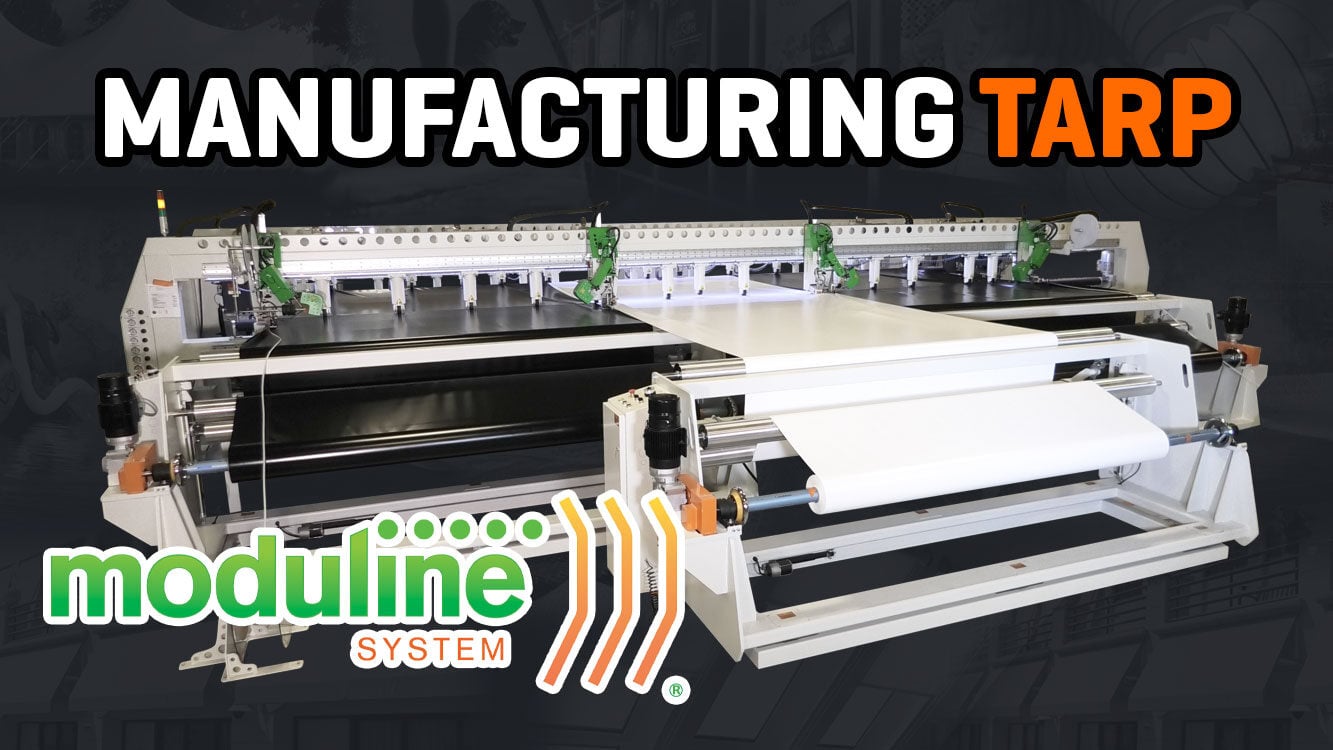
Miller Weldmaster's tarp machines include the EliteAir Industrial hand tool for repairs; the T300 Flex, T600 Flex, T3 Extreme and portable Triad Extreme Cover for batch work; the 112 Extreme, 104 Traveling Welder and Bi-Directional for long seams; the automated Moduline System for Covers and Tarps for production lines; the Moduline for Agricultural Curtains and M100 Single Panel for agricultural curtains; and the RFlex and RFlex Travel for RF welding. See every tarp machine in the machine finder.
| 生産規模 | 素材タイプ | Recommended Configuration |
|---|---|---|
| Low volume / repair | Any weldable thermoplastic | Hand tool |
| Mid volume / batch | PVC, vinyl, PE | Semi-automatic |
| High volume / continuous | PVC, vinyl, heavy coated | Fully automated |
| Variable / mixed products | Multiple materials | Multi-application platform |
| Specialized / custom | どんなものでも | Custom engineered machine |
Industries That Run on Industrial Tarp Welding Equipment
Tarpaulin welding machines are found in production facilities across a wide range of industries — anywhere coated fabric products are manufactured or repaired at scale. Each sector has specific performance requirements that drive machine and material selection.
Transportation and Trucking
Truck tarps, soft side curtains, sliding tarpaulins, and custom side covers for trailers and flatbeds are high-volume production items. Seam integrity is critical — a failed seam at highway speed is a cargo security risk and a liability. Transportation tarp manufacturers run automated welding equipment for long seam runs and use reinforcement welding for attachment point zones. PVC and vinyl are the dominant materials in this sector.
Construction and Heavy Industry
Site protection tarps, equipment covers, scaffold wraps, and temporary structural enclosures are the primary products in this sector. Durability under UV exposure, wind loading, and weather is the performance standard. Coated PE and coated canvas are common material choices. Large-format panels and non-standard dimensions are frequent requirements — making custom machine configurations relevant for high-volume construction tarp producers.
Agriculture and Outdoor Containment
Storage covers, grain tarps, pit covers, and containment liners are the primary tarp applications in agriculture and outdoor containment. Buyers in this segment prioritize cost-effective large-format welding and the ability to handle varying material weights from season to season. Semi-automatic and automated hot air welding configurations are most common in agricultural tarp production facilities.
Tarpaulin Manufacturers and Fabricators
For companies that produce tarps as their core product — for resale, private label, or contract manufacturing — the welding machine is the center of production. Throughput speed, seam consistency, and machine uptime are the three variables that directly affect margins for dedicated tarp fabricators. These operations typically run automated equipment, maintain spare parts inventories, and rely on direct technical support to minimize downtime. Miller Weldmaster's combination of machine performance and post-sale support depth is specifically calibrated for this buyer.